 (281) 242-1061
 Schedule Consultation
Dr. Ravi is a board-certified plastic surgeon with more than 20 years of experience and over 15,000 procedures performed. Fat transfer breast augmentation recovery involves healing in two places at once: the breasts where purified fat is placed and the donor areas where liposuction is performed.
Unlike implant-based augmentation, fat transfer recovery does not involve an implant pocket. Instead, patients are recovering from liposuction while the transferred fat cells gradually integrate with the surrounding breast tissues and establish blood supply.
For many patients, the donor areas feel more sore than the breasts themselves. Swelling, bruising, firmness, and compression-garment use are often more noticeable around the abdomen, flanks, back, thighs, or other areas used to harvest fat.
At Body by Ravi Plastic Surgery & Associates, Dr. Ravi approaches recovery as a combined breast-and-body healing process. His postoperative guidance is designed to protect the transferred fat, support donor-site contour healing, reduce unnecessary pressure on the breasts, and help patients return gradually to normal activity.
Many patients return gradually to light daily activities and desk-based work within several days to about one week, depending largely on the amount and location of liposuction performed. Strenuous activity is restricted longer, while donor-site contour refinement and stabilization of transferred breast fat continue for several weeks to months.
breast swelling, donor-site soreness, bruising, and fatigue are most noticeable
swelling continues and compression garments are often worn over the liposuction areas
many light daily activities can resume
exercise restrictions may begin easing with clearance
breast volume and donor-site contours become easier to evaluate
subtle contour and scar refinement may continue
The exact timeline depends on the amount of transferred fat, the number and location of donor areas, tissue quality, activity level, weight stability, and individual healing.
Fat transfer breast augmentation recovery involves breast swelling and tenderness combined with liposuction-related soreness, bruising, firmness, and swelling in the donor areas. Many patients find that the body-contouring portion of the procedure creates more discomfort than the breast fat placement itself.
Functional recovery often occurs before either the donor contours or breast volume have fully stabilized. Patients may feel well enough for normal routines while deeper healing continues in both treatment areas.
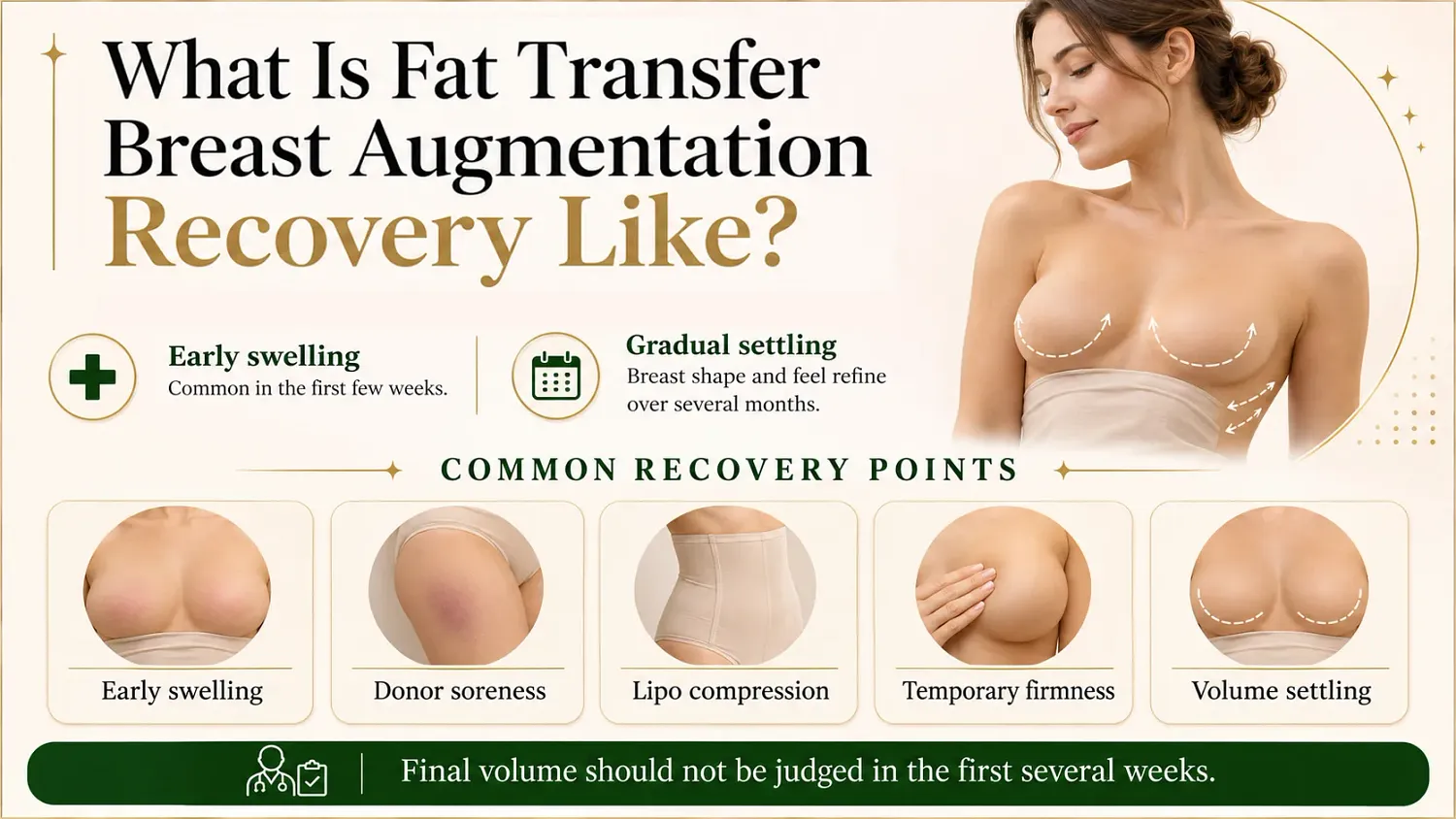
The day of surgery is focused on recovering from anesthesia, protecting the breasts from unnecessary pressure, and supporting the donor areas after liposuction. Patients may feel swollen and tired while the liposuction sites often feel more sore than the breasts.
The breasts may look noticeably larger immediately after surgery because the early appearance includes transferred fat, surgical swelling, and fluid. This should not be interpreted as the final breast size.
The first 48 hours are often when donor-site soreness, swelling, bruising, and fatigue are most noticeable. Patients may also feel tightness where liposuction was performed and fullness in the breasts.
Although discomfort may be manageable, the body is still in the earliest stage of healing. Patients should focus on rest, hydration, nutrition, and carefully following postoperative instructions.
During the remainder of the first week, soreness usually begins improving while bruising, swelling, and donor-site firmness remain. Many patients notice that the liposuction areas continue to feel more uncomfortable than the breasts.
Patients should avoid judging breast volume during this stage. The breasts are still affected by swelling, and the transferred fat is continuing to integrate with surrounding tissue.
The second week often brings a noticeable improvement in energy and mobility. Many patients with desk-based or remote work feel ready to return, especially when the liposuction portion was relatively limited.
Although patients may feel much better, the recovery process is still active. Excessive pressure on the breasts and strenuous exercise should remain limited until cleared.
By weeks three and four, the breasts usually feel softer and the donor areas begin showing more refined contours. Residual swelling and firmness can still be present, especially when multiple donor areas were treated.
This is often when patients begin appreciating both sides of the procedure: breast enhancement and improved donor-site contour.
During weeks four through six, many patients transition toward a broader range of normal physical activity. The breasts feel more natural, while donor-site swelling and firmness continue to decrease.
Patients should still follow Dr. Ravi’s clearance for running, high-impact exercise, heavy lifting, and activities that place pressure on the breasts.
By months two and three, the breast result is generally easier to assess because much of the temporary swelling has resolved. Donor-site contours also continue refining as internal firmness decreases.
This stage gives patients a better sense of the overall direction of the result without relying on early postoperative fullness.
Longer-term recovery involves subtle refinement in both the breasts and the donor areas. Scars continue maturing, body contours become more settled, and long-term breast shape becomes easier to evaluate.
Natural aging and weight changes can still influence the result over time. Fat transfer creates living tissue that remains responsive to changes in the body.
The donor areas can feel more uncomfortable because liposuction affects a broader area of tissue than the small-volume fat injections used in the breasts. Multiple liposuction sites may also be treated to collect enough fat for transfer.
Many patients are surprised that the breast portion feels relatively mild while the donor sites create more soreness. This is one reason fat transfer recovery should be viewed as both a breast procedure and a body-contouring recovery.
Breast swelling is most noticeable during the first several days and gradually decreases over the following weeks. Early swelling temporarily exaggerates breast volume, so the initial postoperative size should not be considered the final result.
Gradual improvement is expected. Sudden one-sided swelling, increasing pain, redness, heat, or rapidly worsening asymmetry should be reported to Body by Ravi Plastic Surgery & Associates.
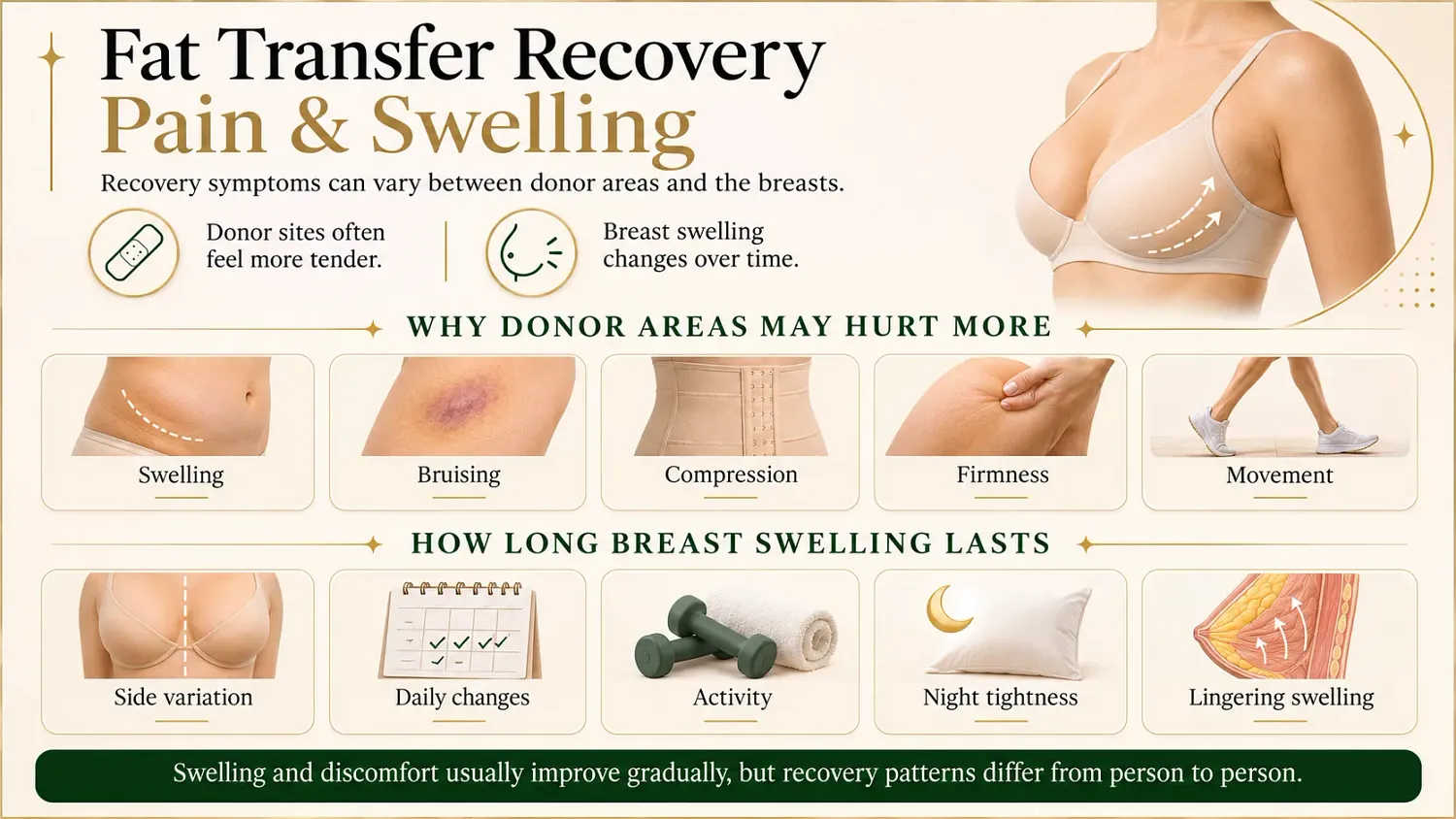
Swelling may look more noticeable later in the day because of activity, gravity, fluid shifts, heat, and time spent upright. This pattern generally becomes less pronounced as healing progresses.
Yes, mild uneven swelling is common during early recovery because the breasts do not always heal at exactly the same rate. A sudden new difference associated with pain, redness, warmth, or rapidly increasing fullness should be evaluated.
Breasts often look smaller after the first few weeks because surgical swelling and temporary fluid are resolving. Some of the initial postoperative fullness therefore disappears even when healing is progressing normally.
This change does not automatically mean that the procedure has failed. Long-term fat retention and permanence are better addressed separately from early recovery, once swelling has resolved and the result has had time to stabilize.
Transferred fat becomes more stable gradually as surviving fat cells integrate with surrounding breast tissue and establish blood supply. The early weeks are important, but breast volume should still be evaluated over months rather than days.
The recovery goal is to create favorable conditions for healing rather than trying to calculate fat survival day by day. Detailed questions about long-term fat retention belong in a dedicated fat-transfer longevity discussion.
Avoiding unnecessary direct pressure on the breasts is an important part of early fat transfer recovery because the transferred tissue is still integrating. Patients should follow Dr. Ravi’s instructions regarding sleep position, bras, massage, and activity rather than assuming that more compression is helpful.
Donor-site compression and breast compression serve different purposes. A garment that is appropriate for a liposuction area may be too restrictive for the newly treated breasts.
Back sleeping is commonly recommended during early recovery because it minimizes direct pressure on the breasts while allowing patients to position themselves comfortably around the liposuction donor areas. Slight upper-body elevation may also make swelling more manageable.
Sleeping instructions should reflect both treatment areas. A position that protects the breasts but places uncomfortable pressure on a liposuction site may need to be modified.
Side sleeping should generally wait until the breasts are sufficiently healed to tolerate pressure and Dr. Ravi has cleared the position. The donor areas also matter, because sleeping on a recently liposuctioned flank or thigh may remain uncomfortable.
Stomach sleeping places direct pressure on the breasts and is usually resumed later. Patients should wait until the breasts are stable and Body by Ravi Plastic Surgery & Associates confirms that direct pressure is appropriate.
Postoperative garments should support the liposuction donor areas without unnecessarily compressing the transferred breast fat. This distinction is important because the donor areas and breasts have different recovery needs.
Proper garment use can help make donor-site recovery more comfortable while protecting the breast result.
Patients should not assume that tighter breast compression is better after fat transfer. Any breast support or compression should follow Dr. Ravi’s specific instructions, while firmer compression is generally directed toward the liposuction donor areas rather than the newly grafted breasts.
The length of donor-site compression depends on how much liposuction was performed, which areas were treated, swelling, skin quality, and individual healing. Patients should follow the garment timeline provided by Body by Ravi Plastic Surgery & Associates rather than relying on a universal number of weeks.
Compression is only one part of donor-site healing. Contour refinement and internal softening continue even after patients stop wearing the garment.
Liposuction donor areas can feel hard, uneven, or lumpy during early healing because of swelling, fluid shifts, tissue inflammation, and internal remodeling. These areas often soften progressively even after visible bruising has disappeared.
Gradual softening is generally reassuring. Increasing pain, redness, warmth, or rapidly enlarging swelling should be evaluated promptly rather than assumed to be normal liposuction firmness.
Firmness should be discussed with the surgical team if it becomes increasingly painful, hot, red, dramatically asymmetric, or progressively worse rather than softer. Body by Ravi Plastic Surgery & Associates can determine whether the change reflects expected healing or needs clinical assessment.


Exercise after fat transfer breast augmentation needs to account for two healing areas: the breasts and the liposuction donor sites. Although movement is encouraged early, returning to strenuous exercise too quickly can increase swelling, irritate donor areas, and place unnecessary pressure or movement on the breasts.
The safest approach is gradual progression based on how the breasts and donor areas are healing. Feeling energetic again does not necessarily mean the deeper tissues have finished recovering.
Gentle walking is encouraged early after surgery because it promotes circulation without placing significant strain on the breasts or donor areas.
Walking can help:
During the first several days, walks should be short and comfortable. Distance and pace can gradually increase as soreness improves.
Low-impact cardiovascular exercise can generally be introduced later in recovery after Dr. Ravi confirms that healing is progressing appropriately.
Patients may gradually transition to activities such as:
The goal is to increase activity without creating significant breast bouncing, pressure, or donor-site discomfort.
Running creates considerably more breast movement and impact than walking. For this reason, it should not be treated as an early recovery activity.
Before returning to running, patients should have adequate healing of both the breasts and donor areas and should be able to exercise without increasing pain or swelling. Appropriate breast support is also important once Dr. Ravi has cleared higher-impact activity.
The timing of lower-body exercise depends partly on where fat was harvested. A patient whose donor sites include the thighs or hips may need a different progression from someone whose fat was primarily harvested from the abdomen or flanks.
Squats, lunges, resistance machines, and other lower-body movements should therefore be reintroduced gradually rather than according to a universal timeline.
Upper-body training deserves additional caution because certain movements can increase breast motion or pressure.
Activities such as:
should wait until Dr. Ravi determines that the breasts have healed sufficiently.
Planking and abdominal exercises can be surprisingly uncomfortable when the abdomen or flanks were used as donor areas. Even though these exercises do not directly target the breasts, they can place considerable tension through recently treated abdominal tissues.
Core training should therefore be resumed according to donor-site healing rather than simply how comfortable the breasts feel.
Heavy resistance training, HIIT, jumping, and other high-impact activities should be among the later stages of the exercise progression.
When cleared, patients should:
A controlled return to exercise protects both components of the result: the newly enhanced breasts and the liposuction contours.
Return to work after fat transfer breast augmentation depends heavily on the extent of liposuction and the physical demands of the patient's occupation. For many patients, donor-site soreness influences work readiness more than breast discomfort.
Many patients with sedentary jobs can consider returning to work within several days to about one week if they are comfortable, mobile, and no longer using medication that affects alertness.
Remote work may make the transition easier because patients can adjust their position, take short walks, and manage garments more privately.
Jobs involving prolonged standing, frequent walking, reaching, or bending may require additional recovery time. Even if these activities do not directly affect the breasts, they can aggravate swollen liposuction areas.
Returning gradually can help prevent unnecessary increases in soreness and swelling.
Patients whose work involves lifting, pushing, pulling, repetitive upper-body activity, or strenuous physical effort generally require more time before returning without restrictions.
Dr. Ravi provides individualized guidance because the appropriate timeline depends on the breast treatment, donor areas, and demands of the patient's job.
Patients can consider returning to driving when they are no longer taking narcotic or otherwise sedating pain medications and can safely control a vehicle without significant discomfort.
Before driving, you should be able to:
Donor-site location matters. Abdominal, flank, back, or thigh soreness can make driving uncomfortable even when the breasts feel relatively normal.
Safety rather than a predetermined postoperative day should determine when driving resumes.
Sex and intimacy increase heart rate and physical activity and can also create accidental pressure on the breasts or healing donor areas. For those reasons, intimacy should return gradually after the early recovery period and according to Dr. Ravi's instructions.
When intimacy resumes:
Gentle contact and normal touch are different from firm squeezing, massage, or prolonged pressure. During early fat integration, patients should avoid aggressive manipulation unless Dr. Ravi has specifically instructed otherwise.
As healing progresses, restrictions can gradually ease. Patients should follow the guidance provided by Body by Ravi Plastic Surgery & Associates rather than assuming that the absence of pain means all breast pressure is appropriate.
Nutrition provides the body with the building blocks needed for tissue repair. Fat transfer patients should focus on adequate nourishment rather than restrictive dieting during early recovery.
A balanced postoperative diet may include:
Protein is particularly important for general tissue healing. Hydration can also help patients feel better during recovery and support normal bowel function, especially when postoperative medications contribute to constipation.
Patients should avoid behaviors that interfere with healing or create unnecessary nutritional stress.
Important considerations include:
Patients should follow the medication, supplement, and dietary instructions provided by Dr. Ravi rather than beginning new products during recovery without discussing them with the surgical team.
Yes. Once transferred fat survives and becomes established, it behaves like fat elsewhere in the body. Significant weight loss can therefore reduce the volume of the fat cells and alter breast fullness.
This is particularly important during recovery. Aggressive dieting immediately after surgery can make it harder to evaluate the developing result and may not provide the nutritional support the body needs for healing.
Patients should generally aim for:
Long-term questions about how weight changes affect fat-transfer durability are better addressed separately from the immediate recovery process.
Fat transfer breast augmentation generally uses small access points for liposuction and fat placement rather than the longer breast incisions associated with procedures such as a breast lift.
During early healing, these small sites may appear:
Their appearance usually becomes more discreet as healing and scar maturation continue.
Sun protection is particularly important once incisions are healed enough to be exposed because ultraviolet exposure can make developing scars more noticeable.
Dr. Ravi considers scar quality part of the overall surgical result. Scar optimization begins with thoughtful access-point placement and careful tissue handling and continues during postoperative care.
Depending on individual healing, recommendations may include:
Not every patient needs every scar treatment. Dr. Ravi evaluates how each incision is maturing before recommending additional therapy.
Most fat transfer breast augmentation recoveries include some swelling, bruising, tenderness, and temporary unevenness. The important distinction is whether symptoms are gradually improving or becoming suddenly or progressively worse.
Patients should contact Body by Ravi Plastic Surgery & Associates if they develop:
Calling with a concern does not mean that a complication has occurred. Early communication allows the surgical team to determine whether a change is part of normal healing or needs evaluation.
Certain symptoms should not wait for a routine postoperative call. Seek urgent medical attention for symptoms such as:
Patients receive specific postoperative instructions from Body by Ravi Plastic Surgery & Associates that should take priority over general online recovery information.
Fat transfer recovery is less about finding shortcuts and more about creating a favorable environment for both donor-site healing and transferred-fat integration.
Not every factor affecting transferred fat is within a patient's control. However, certain behaviors can create a less favorable healing environment and should be avoided.
Nicotine constricts blood vessels and can interfere with healthy circulation. Patients should follow Dr. Ravi's instructions regarding smoking, vaping, nicotine replacement products, and other sources of nicotine before and after surgery.
Transferred fat behaves like natural fat once established. Aggressive weight loss can reduce breast volume and makes the developing result more difficult to assess.
Sleeping directly on the breasts, wearing excessively tight garments, or applying aggressive massage can create unnecessary pressure during early healing.
Intense exercise can increase swelling and repetitive breast movement while also stressing healing donor areas. Activity should progress according to surgical clearance.
The body requires adequate nutrients and energy for tissue repair. Severe dietary restriction is therefore not appropriate during early postoperative healing.
Generic advice cannot account for the amount of fat transferred, the donor sites treated, or the details of an individual operation. The instructions provided by Dr. Ravi should always take priority.
Fat transfer breast augmentation has a distinctive recovery because patients are healing from both breast fat placement and liposuction. The breasts may feel relatively comfortable while the donor areas remain bruised, swollen, firm, or tender.
Key recovery points include:
Fat transfer breast augmentation recovery is best understood as a combined breast-and-body healing process. Following a personalized recovery plan allows both treatment areas the time they need to settle and refine.
Dr. Ravi is a board-certified plastic surgeon with more than 20 years of experience and over 15,000 procedures performed. His approach to fat transfer breast augmentation combines breast aesthetics with advanced body contouring principles, including SAFE liposuction techniques.
Recovery planning is individualized according to the amount of fat transferred, donor areas treated, tissue quality, and each patient's lifestyle. Enhanced Recovery protocols and multimodal pain-management strategies are incorporated when appropriate.
Dr. Ravi works with an experienced surgical team that includes a board-certified anesthesiologist, skilled nurses, and a first assistant with multiple years of plastic surgery expertise. Together, the team works in unison with a focus on patient safety, surgical precision, and attentive postoperative care.

Recovery planning begins before surgery. During a consultation, Dr. Ravi can evaluate whether you have adequate donor fat, identify potential liposuction areas, discuss the degree of breast enhancement you are hoping to achieve, and explain how your individual surgical plan may affect recovery.
Your consultation can also address practical questions about compression garments, sleeping, work, exercise, weight stability, donor-site healing, and when you can expect your breast volume to become more predictable.
Schedule a consultation with Dr. Ravi at Body by Ravi Plastic Surgery & Associates in Houston, TX, to learn whether fat transfer breast augmentation is appropriate for your anatomy and what recovery may involve for both your breasts and donor areas.
The donor areas often feel more sore because liposuction affects a broader area of tissue than the small-volume fat injections used in the breasts. Bruising, swelling, compression garments, and internal firmness can make the abdomen, flanks, back, or thighs feel more uncomfortable during early recovery.
The breasts often look smaller after the first few weeks because early swelling and surgical fluid are resolving. This does not automatically mean too much fat was lost, because the long-term breast volume becomes easier to judge only after healing has progressed further.
Yes, one breast may soften or lose swelling faster because each side can heal at a slightly different rate. Mild temporary asymmetry is common, but sudden swelling, increasing pain, redness, or a dramatic new difference should be reported to Body by Ravi Plastic Surgery & Aesthetics.
Side sleeping should generally wait until the breasts are sufficiently healed to tolerate pressure and Dr. Ravi has cleared the position. Donor-site location also matters because sleeping on a recently treated flank, hip, or thigh may remain uncomfortable.
Excessive breast compression may place unnecessary pressure on newly transferred fat during early healing. Patients should wear only the breast support recommended by Dr. Ravi and should not assume that tighter compression is better.
The duration of compression depends on the amount of liposuction performed, the donor sites treated, swelling, and individual healing. Dr. Ravi will advise when it is appropriate to reduce garment use or transition out of compression.
Firmness or lumpiness can develop because of swelling, fluid shifts, inflammation, and internal tissue remodeling after liposuction. These areas often soften gradually, but worsening pain, redness, warmth, or rapidly increasing swelling should be evaluated.
Running, jumping, and other high-impact exercise should resume only after both the breasts and donor areas have healed enough to tolerate repeated movement and impact. Dr. Ravi will provide individualized clearance based on the amount of fat transfer, liposuction extent, and your recovery progress.
Yes, significant weight loss can reduce breast volume because surviving transferred fat behaves like natural body fat. Maintaining a stable weight during recovery also makes it easier to evaluate the developing result more accurately.
Breast size should not be judged during the first several weeks because swelling temporarily exaggerates volume and the tissues are still stabilizing. Most patients gain a clearer sense of their long-term breast size over the following few months as swelling resolves and the result becomes more stable.