 (281) 242-1061
 Schedule Consultation

Published
14 minute read
The eyes have a way of revealing more than we intend. Under-eye bags, loose skin, puffiness, and shadows can create a tired or older appearance even when someone feels energetic and healthy. For some patients, those changes appear gradually with age. For others, genetics make lower eyelid fullness noticeable much earlier. Either way, the concern is often not about looking dramatically younger. It is about wanting the face to look as rested and vibrant as the person feels.
For Mathew L. Moreno, MD, fellowship-trained plastic surgeon at Body by Ravi Plastic Surgery & Associates in Houston, Texas, lower eyelid surgery is an exercise in precision and restraint. His philosophy is simple: restoration, not transformation. Rather than aggressively removing tissue, Dr Moreno evaluates the fat, skin, eyelid support, and surrounding facial anatomy individually. The objective is a natural-looking result that softens the signs of fatigue while preserving the expression, shape, and character of the eyes.
Lower blepharoplasty is a surgical procedure designed to improve age-related or hereditary changes affecting the lower eyelids. Although patients often describe the procedure as "removing eye bags," the surgery is more nuanced than that. The lower eyelid contains delicate layers of skin, muscle, fat, connective tissue, and supporting structures, all of which contribute to its appearance.
A successful lower blepharoplasty begins by identifying which structures are responsible for the patient's concerns. In some people, prominent orbital fat is the primary issue. In others, loose skin, eyelid laxity, volume loss, or poor skin quality may be equally important. Dr Moreno's approach is based on treating the anatomy that is actually present rather than performing the same operation on every patient.
Common concerns treated with lower blepharoplasty may include:
One of the most common causes of lower eyelid bags is the gradual prominence of orbital fat. Fat naturally surrounds and cushions the eye, but over time, the tissues that hold it in position can change. This can allow fat to become more visible beneath the lower eyelid, creating the characteristic fullness many patients describe as puffiness or "bags."
Age is not the only factor. Genetics can be powerful, and some people notice lower eyelid fullness in their 20s or 30s. Skin quality, cheek volume, bone structure, sun exposure, and eyelid support can also influence how the area looks. This is why Dr Moreno does not regard under-eye aging as a single problem with a single solution.
Factors that may contribute include:
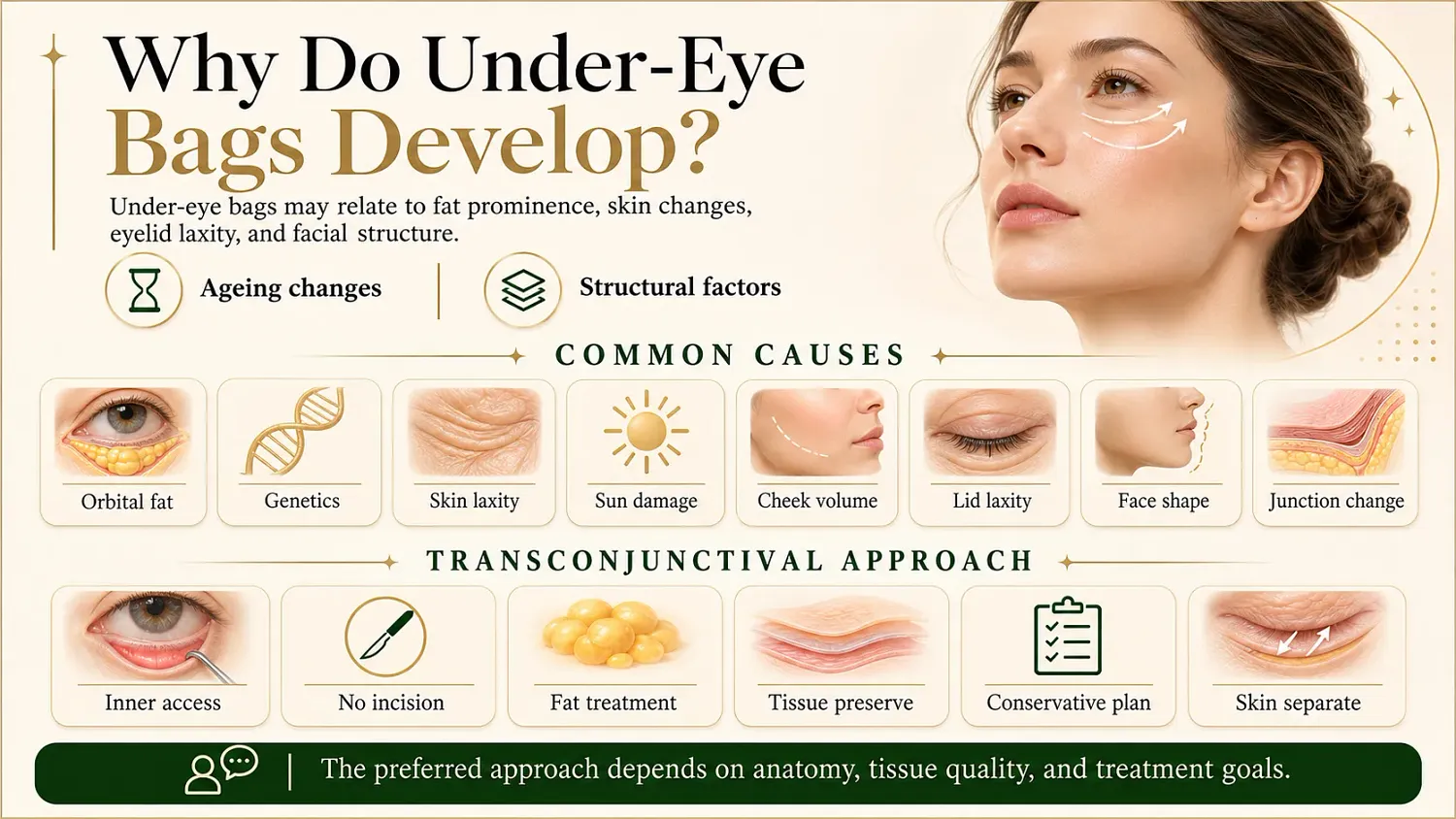
When herniated lower eyelid fat is the main concern, Dr Moreno favors a transconjunctival lower blepharoplasty in appropriately selected patients. This approach accesses the lower eyelid from the inside surface rather than through a routine external incision beneath the eyelashes.
For Dr Moreno, the appeal of the transconjunctival technique is that it can allow the deeper fat compartments to be addressed while preserving the external lower eyelid skin and muscle when those tissues do not need to be disturbed. It reflects his broader surgical philosophy of changing only what needs correction and preserving as much normal anatomy as possible.
Potential advantages of this approach in appropriate patients include:
The orbicularis oculi is the circular muscle surrounding the eye and plays an important role in eyelid function, expression, and support. Dr Moreno does not routinely excise the orbicularis muscle during lower blepharoplasty.
This conservative philosophy is partly intended to respect lower eyelid support and reduce unnecessary disruption of structures around the eye. Lower eyelid surgery must be performed thoughtfully because excessive removal of skin or supporting tissue can contribute to undesirable changes in eyelid position. Dr Moreno's preference is to preserve tissue when removing it is not essential to achieving the patient's goal.
His approach emphasizes:
It is easy to assume that lower eyelid aging is primarily caused by loose skin. In reality, patients may have significant under-eye bags with very little excess skin, while another patient may have minimal fat prominence but visible crepiness or laxity. Treating both patients in exactly the same way would be unlikely to produce equally refined results.
Dr Moreno therefore separates treatment of the deeper anatomy from treatment of the skin. The fat compartments, eyelid support, skin quality, and amount of true skin excess are assessed independently. This allows the surgical plan to be tailored rather than automatically removing skin whenever lower blepharoplasty is performed.
Questions considered during planning may include:
Skin quality can be just as important as fat prominence. Fine lines, texture changes, crepiness, and sun damage may remain even after the deeper lower eyelid anatomy has been improved. In selected patients, combining surgery with an appropriate skin treatment may create a more complete result.
Dr Moreno considers Fitzpatrick skin type when evaluating resurfacing. For appropriate patients with Fitzpatrick Types I through III, his treatment plan may include CO2 laser resurfacing or a deep chemical peel. For Fitzpatrick Types IV through VI, he may instead favor a limited skin-pinch blepharoplasty when skin removal is indicated.
Skin treatment may therefore involve:
A skin-pinch blepharoplasty is a conservative technique designed to remove a limited amount of excess lower eyelid skin without routinely excising the underlying orbicularis muscle. The concept is straightforward: remove only the amount of skin necessary to improve laxity while minimizing tension on the lower eyelid.
The lower eyelid is a delicate structure, and more skin removal does not necessarily mean a better result. Excessive tightening can alter eyelid position or shape. Dr Moreno's philosophy is therefore to use a measured approach in which preservation is treated as an important part of aesthetic surgery.
A limited skin-pinch approach may be considered when:
Not every patient begins with the same degree of lower eyelid support. Some patients have good structural tone, while others have laxity that could become more important after surgery. Assessing this before an operation is an essential part of surgical planning.
When Dr Moreno identifies meaningful lower eyelid laxity, he may perform a canthopexy, a supportive procedure involving the canthal tendon at the outer corner of the eyelid. The goal is not simply to make the eyelid tighter. It is to support appropriate position and maintain harmony between the eyelid and the eye.
Canthopexy may be considered when:
Many patients describe a visible shadow or hollow between the lower eyelid and the cheek. This area, often referred to as the eyelid-cheek junction, plays a major role in whether the eyes look rested or fatigued. Aging in this region may involve both protruding fat above and volume loss below.
For selected patients, Dr Moreno may incorporate nanofat to the lower eyelid region to help smooth the lid-cheek junction and improve skin quality. This illustrates an important principle of modern facial rejuvenation: not every aging change should be treated by removing tissue.
Improving the eyelid-cheek transition may involve:
Upper and lower blepharoplasty are related procedures, but they address different anatomical concerns. Upper eyelid surgery commonly focuses on excess upper eyelid skin and selected fat prominence, while lower eyelid surgery more often addresses under-eye fat, skin quality, laxity, and the eyelid-cheek junction.
Dr Moreno uses a similarly conservative philosophy in upper blepharoplasty. He does not routinely remove orbicularis muscle, treats upper eyelid fat conservatively, and aims to avoid excessive hollowing or an A-frame deformity. In selected patients, fat grafting may be considered to maintain or restore upper eyelid and brow fullness.
Upper and lower eyelid treatment may therefore differ in:
The upper third of the face functions as a connected aesthetic unit. A patient may believe that upper eyelid skin is the entire problem when brow descent is contributing significantly to the sense of heaviness. Removing more eyelid skin in that situation may not address the true cause.
Dr Moreno evaluates brow position as part of facial rejuvenation planning. His browlift philosophy includes assessing skin bunching, determining whether temporal brow treatment is necessary, releasing relevant retaining ligaments, and suspending the brow without relying on palpable fixation devices such as endotynes.
A comprehensive assessment may therefore examine:
There is no single age at which lower blepharoplasty becomes appropriate. Some people develop prominent bags relatively young because of genetics, while others notice them later as the eyelid tissues change with age.
The best candidates are generally healthy individuals with a clearly identifiable anatomical concern and realistic expectations about what surgery can accomplish. Dr Moreno approaches the consultation as a conversation rather than a sales pitch. He emphasizes careful listening, education, honest recommendations, and individualized planning.
Potential candidates may have:
Blepharoplasty can create meaningful improvement, but it cannot correct every issue in the under-eye region. Some concerns come primarily from pigmentation, muscle activity, cheek volume loss, or skin texture rather than excess fat or skin.
This is why a precise diagnosis matters. A technically successful operation can still disappoint a patient if the concern they hoped to correct was never primarily surgical. Dr Moreno believes setting realistic expectations during consultation is as important as the procedure itself.
Lower blepharoplasty alone may not completely correct:

For many patients, one of the greatest fears is not the surgery itself but the possibility of looking unfamiliar afterward. The eyes are central to identity and expression, so even subtle changes in shape can be noticeable.
Dr Moreno's stated aesthetic philosophy is natural, refined results and restoration rather than transformation. With lower blepharoplasty, this means reducing distracting signs of fatigue while respecting the patient's existing eye shape and facial proportions.
The goal is typically to create an appearance that feels:
Recovery varies depending on the exact operation and whether lower blepharoplasty is performed alone or in combination with another facial procedure. Swelling and bruising are expected in the early stages and can vary considerably between patients.
The early postoperative appearance is not the final result. The tissues need time to settle and swelling gradually resolves. Dr Moreno emphasizes attentive communication and follow-up throughout the recovery process, reflecting his broader belief that patient care extends well beyond the operating room.
Patients should expect individualized guidance regarding:
All surgical procedures involve risk, and lower blepharoplasty is no exception. Because the lower eyelid plays both an aesthetic and functional role, careful patient selection and surgical planning are especially important.
Potential complications can vary according to the procedure performed, individual anatomy, previous surgery, skin quality, medical history, and healing characteristics. No surgeon can eliminate risk entirely, which is why informed consent and realistic expectations are essential.
Potential risks may include:
Lower eyelid surgery can be performed as a standalone procedure or combined with other facial rejuvenation procedures when the anatomy and patient's goals justify it. Treating multiple areas can sometimes produce a more balanced result when aging changes extend beyond the eyelids.
Facial procedures are a central part of Dr Moreno's clinical interests. His priority facial procedures at Body by Ravi include deep plane facelift, minimally invasive neck lift, upper and lower blepharoplasty, and browlift. The decision to combine surgery, however, should be based on a clear anatomical reason rather than simply performing more procedures.
Potential combinations may include:
Patients searching for lower blepharoplasty in Houston will encounter many procedure descriptions, surgical techniques, before-and-after galleries, and marketing claims. Technique is important, but surgical judgment is equally important because the lower eyelid has very little tolerance for excessive treatment.
Dr Moreno completed six years of integrated plastic surgery residency training at the University of Kansas Medical Center, including Chief Resident experience, followed by an aesthetic surgery fellowship at Aristocrat Plastic Surgery in New York. His background includes a strong operative foundation in facial aesthetics, and his approach emphasizes precision, proportion, restraint, and patient-centered planning.
Questions worth asking during a lower blepharoplasty consultation include:
Lower blepharoplasty is the broader surgical procedure. Removing or addressing prominent orbital fat may be one part of it, but surgery can also involve treatment of skin quality, eyelid laxity, and the relationship between the lower eyelid and cheek.
For appropriate patients with prominent lower eyelid fat, Dr Moreno favors a transconjunctival approach, which accesses the fat from inside the lower eyelid rather than routinely making a subciliary incision beneath the lashes.
Yes. In selected patients, Dr Moreno may use a limited skin-pinch technique and does not routinely excise the orbicularis muscle during lower blepharoplasty.
Sometimes the appearance of dark circles improves when under-eye contour and shadowing improve, but pigmentation, thin skin, cheek volume loss, and other factors can also cause darkness. Surgery cannot guarantee elimination of every dark circle.
Dr Moreno assesses lower eyelid laxity during consultation. When additional support is indicated, he may perform a canthopexy involving the canthal tendon.
For selected patients, yes. Dr Moreno may consider CO2 laser resurfacing or a deep peel for appropriate Fitzpatrick Types I through III. For Fitzpatrick Types IV through VI, he may favor a limited skin-pinch approach when skin treatment is necessary.
Yes, when both areas would benefit from treatment and the patient is an appropriate surgical candidate. Dr Moreno evaluates the eyelids, brow, skin quality, fat distribution, support, and surrounding facial anatomy before recommending whether one or both areas should be treated.
Published
2 minute read
The best lower blepharoplasty should not announce itself. It should quiet the puffiness, heaviness, or under-eye changes that have begun to distract from the rest of the face. Dr Mathew Moreno's approach is centered on thoughtful assessment, conservative tissue handling, and natural rejuvenation that preserves the character of the eyes rather than reshaping them unnecessarily.
If you are considering lower blepharoplasty in Houston, schedule a consultation with Dr Mathew Moreno at Body by Ravi Plastic Surgery & Associates to learn whether transconjunctival lower eyelid surgery, skin treatment, canthopexy, nanofat, or a customized combination may be appropriate for you. The goal is not to look like someone else. It is to look rested, refreshed, and unmistakably yourself.