 (281) 242-1061
  Schedule Consultation

Published
10 minute read
For many patients, the decision to explore facelift surgery begins quietly. The jawline looks softer in photographs. The cheeks seem lower than they once did. Early jowls become more visible. The transition between the face and neck feels less defined. After significant weight loss, some patients notice that their healthier body is accompanied by a face that appears more deflated or lax. The concern is rarely, "I want to look like somebody else." More often, it is, "I want to look like myself again."
That distinction is central to how Dr Mathew Moreno approaches facelift surgery in Houston. His philosophy is based on restoration, not transformation. Rather than simply pulling the skin tighter, Dr Moreno focuses on understanding how the deeper facial tissues have changed and how they can be repositioned while preserving the patient's identity. For patients comparing a mini facelift, traditional facelift, deep plane facelift or combined face and neck rejuvenation, the goal is not to choose the procedure with the most impressive name. It is to choose the operation that best matches the anatomy, degree of aging and desired result.
Facial aging is not simply a problem of excess skin. As we age, the facial fat compartments change in volume and position, deeper support structures loosen, skin elasticity decreases and the relationship between the cheeks, jawline and neck gradually changes. Jowls may develop, the lower face may appear heavier and the once-defined angle between the jaw and neck can become less distinct.
This is why modern facelift surgery focuses on more than skin removal. A comprehensive facelift may address the superficial musculoaponeurotic system, or SMAS, along with other deeper supporting tissues. By repositioning these layers, the surgeon can improve facial contour while avoiding excessive reliance on skin tension. The objective is not simply a tighter face, but a more youthful relationship between the facial structures.
A deep plane facelift is an advanced facial rejuvenation approach in which the surgeon works beneath the SMAS in selected areas and releases supporting structures that can restrict movement of the facial tissues. This allows the skin and deeper tissues to be mobilized together as a composite unit rather than placing most of the lifting force on the skin.
Dr Moreno's extended deep plane facelift philosophy incorporates this composite-flap approach, limited skin undermining and careful mobilization of deeper tissues. His direction of lift is planned to support a defined jawline without creating an overly horizontal or windswept appearance. The intended result is a face that looks naturally younger, refreshed and recognizable.
One of the most important concepts in modern facelift surgery is tissue mobility. Facial tissues cannot always be effectively repositioned simply by pulling on them or placing a few sutures. Retaining ligaments and deeper attachments may need to be released so that the facial tissues can move into a more favorable position.
Dr Moreno places considerable emphasis on mobilizing the deeper facial layers before securing them. In his view, durable rejuvenation depends on understanding where tissues are restricted, releasing those structures when appropriate and repositioning the tissues along a thoughtful vector. The goal is not maximal tightness. It is controlled movement and stable support.
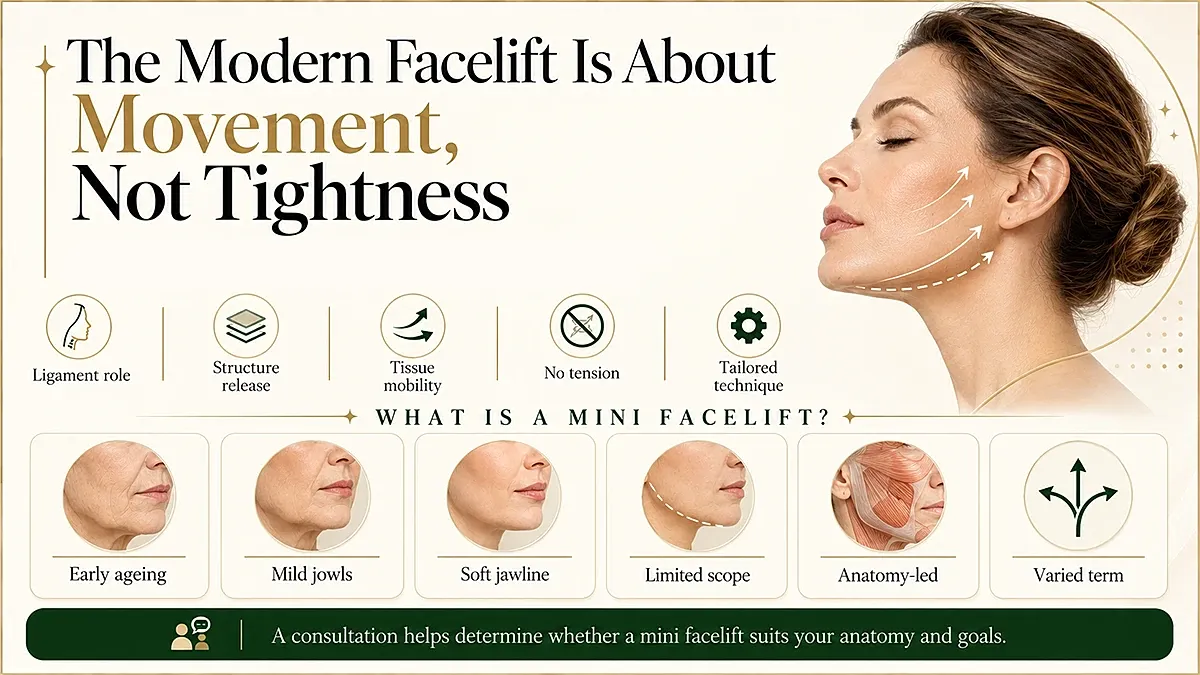
The term mini facelift is widely used but not universally defined. In general, it describes a more limited facial lifting procedure that may be considered for patients with earlier or less extensive signs of lower-face aging. Depending on the surgeon and the patient's anatomy, it may involve a smaller treatment area or less extensive tissue mobilization than a comprehensive facelift.
The appeal is easy to understand. Patients often associate the word "mini" with shorter incisions, a smaller operation and an easier recovery. But a mini facelift should not be viewed as a smaller version of every facelift that produces the same result with less surgery. Its usefulness depends on whether the patient's concerns are genuinely limited enough to be addressed with a limited procedure.
The most useful question is not, "What is the smallest operation I can have?" It is, "What is the least extensive operation capable of appropriately treating my concerns?" A patient with modest lower-face laxity may not require an extensive procedure, while someone with significant jowling, deeper tissue descent or neck aging may find that a limited operation does not produce enough improvement.
This is where surgical judgment becomes particularly important. Choosing a smaller operation simply because it sounds easier can lead to disappointment if the procedure cannot adequately address the patient's anatomy. Conversely, performing a larger operation when a more limited procedure would suffice may represent unnecessary treatment. The right approach lies between those two extremes.
A mini facelift may enter the conversation when aging changes are relatively early and concentrated around the lower face. Some patients primarily notice mild jowling or a loss of crispness along the jawline while maintaining relatively good skin elasticity and limited neck aging.
However, candidacy cannot be determined from age alone or from a photograph of the jawline. A patient may believe the issue is mild facial laxity when the more significant concern is actually platysmal banding, submental fullness or deeper neck anatomy. A careful examination is necessary before deciding whether limited surgery is likely to meet the patient's expectations.
Patients with more pronounced jowls, significant lower-face descent or combined face and neck aging may require a more comprehensive operation to achieve a meaningful result. A limited procedure may improve one component of aging while leaving another untreated, which can create an imbalance between the face and neck.
The term "mini" can sometimes create unrealistic expectations because it sounds as though patients can achieve a full facelift result with less surgery. That is not always possible. If deeper tissues require broader mobilization or if the neck plays a major role in the patient's concerns, a more comprehensive plan may be necessary.
Significant weight loss can produce substantial changes in the face. Patients who lose weight with medications such as semaglutide or tirzepatide may notice reduced facial fullness, more visible folds, skin laxity or a less defined jawline. The popular phrase "Ozempic face" often oversimplifies these changes because weight loss may affect both volume and tissue support.
Dr Moreno approaches post-GLP-1 facial rejuvenation by distinguishing between volume loss and tissue descent. A facelift may reposition sagging tissues, but it does not automatically replace volume that has disappeared. For selected patients, facial fat grafting may be considered alongside lifting procedures to restore proportion rather than simply tightening the face.
The word "natural" is used frequently in plastic surgery, but for Dr Moreno it has a specific meaning. Natural does not mean that there should be no visible improvement. Patients come to surgery because they want change. The goal is for that change to remain consistent with the patient's facial proportions, expression and identity.
Dr Moreno believes the difference between an elegant result and an overdone result often comes down to restraint. A jawline can become sharper without looking artificially tight. The cheeks can appear more youthful without looking exaggerated. The face can look refreshed without every line being erased. This philosophy guides his approach to facial rejuvenation.
In Dr Moreno's extended deep plane facelift technique, limited skin undermining is used while greater attention is placed on the deeper structural layers. This reflects the principle that the skin should not be expected to carry the entire lifting force when deeper tissue descent is contributing to the visible signs of aging.
After the deeper tissues are appropriately mobilized and repositioned, the skin can be redraped more naturally. Dr Moreno also uses techniques intended to reduce dead space rather than routinely relying on drains in facelift surgery. These choices form part of a broader approach centered on anatomical repositioning and controlled tissue handling.
Patients often use the word "facelift" to describe changes involving the cheeks, jawline and neck, but these regions contain different anatomical structures. A facelift primarily addresses the face and jawline, while neck surgery may address loose skin, platysmal banding, submental fullness and deeper neck structures.
Dr Moreno evaluates the face and neck as connected aesthetic regions. His neck lift philosophy incorporates techniques designed to address platysmal banding and deeper anatomy when indicated, while also focusing on stable tissue support. Some patients need combined treatment, while others may benefit from a more isolated facial or neck procedure.


Published
6 minute read
A facelift can improve the appearance of certain folds and laxity, but it is not primarily a resurfacing treatment. Fine lines, pigmentation, sun damage and rough texture occur within the skin itself and may persist even after deeper facial tissues have been repositioned.
For this reason, a complete facial rejuvenation plan may involve more than surgery. Depending on the patient's skin type and concerns, treatments such as laser resurfacing, chemical peels or medical-grade skin care may be considered separately. The goal is to identify whether the patient's concern comes from skin quality, tissue position, volume loss or a combination of all three.

Facial aging rarely occurs in only one region, so some patients may benefit from combining facelift surgery with eyelid or brow procedures. The purpose of combining surgery should be to create facial harmony, not simply to perform more procedures during one operation.
Dr Moreno approaches upper eyelid surgery conservatively, avoiding routine orbicularis muscle excision and addressing upper-eyelid fat carefully to reduce the risk of a hollow appearance. His lower eyelid approach favors a transconjunctival technique when appropriate, allowing access from inside the eyelid. Brow position is also assessed individually before deciding whether a brow lift is needed.
Recovery after facelift surgery varies according to the extent of surgery, the procedures performed and the patient's individual healing response. Swelling and bruising are expected during the early period, and the face may initially look fuller or less defined than the eventual result.
Patients should understand that social recovery and complete healing are not the same thing. A patient may feel ready to resume selected activities while subtle swelling remains. Incisions and tissues continue to mature over time, which is why early photographs do not represent the final outcome.
Like every surgical procedure, facelift surgery carries potential risks. These may include bleeding, hematoma, infection, delayed wound healing, unfavorable scarring, sensory changes, asymmetry, contour irregularities, hairline changes and injury to branches of the facial nerve. Anesthesia also involves its own risks.
Careful patient selection, medical evaluation and surgical planning are therefore essential. Patients should disclose nicotine use, medications, supplements, previous facial surgery, fillers, threads and energy-based procedures. Expectations should also be discussed clearly before surgery because anatomical limitations can influence what can realistically be achieved.
A facelift does not stop the aging process. Instead, it repositions tissues to a more youthful starting point while aging continues naturally from there. Skin quality, genetics, sun exposure, weight fluctuations and lifestyle can all affect how the result changes over time.
For this reason, it can be misleading to promise that every facelift will last a specific number of years. A better goal is to perform appropriate tissue repositioning and then support the result with stable weight, sun protection and thoughtful long-term skin care.
There is no single ideal age for facelift surgery. Some patients develop meaningful lower-face laxity in their 40s, particularly after weight changes, while others may reach their 60s with relatively modest tissue descent. Chronological age gives context, but it does not determine the operation.
Dr Moreno evaluates facial anatomy, skin quality, volume distribution, jawline definition and neck changes before recommending treatment. This anatomy-first approach helps determine whether a patient might benefit from a mini facelift, comprehensive facelift, neck lift, fat grafting or another facial procedure.
The most useful distinction is between limited correction and comprehensive correction. A mini facelift may be appropriate when the anatomical concern is genuinely limited. A more extensive facelift may be needed when jowling is pronounced, deeper tissues require greater mobilization or the face and neck have aged together.
Neither procedure is automatically superior. Choosing the right operation means balancing what the patient wants to improve with what the anatomy actually requires. Dr Moreno's goal is to recommend the least extensive procedure that can realistically deliver the degree of improvement the patient is seeking.
Dr Moreno views the facelift consultation as a conversation rather than a sales process. Patients often arrive after months of online research and may already have a procedure in mind. The first step, however, is understanding what they actually see when they look in the mirror and what they hope will change.
The examination then considers the face as a connected anatomical structure, including the brow, eyelids, cheeks, facial volume, jawline, neck and skin quality. Only after combining the patient's goals with the anatomical findings does it make sense to recommend a mini facelift, extended deep plane facelift, neck lift, fat grafting, eyelid surgery or another approach.
A mini facelift generally describes a more limited operation intended for earlier or less extensive lower-face aging. A comprehensive facelift may address broader tissue descent and may involve more extensive deeper tissue mobilization. Because "mini facelift" is not a universally standardized term, patients should ask exactly what tissues and areas will be treated.
A deep plane facelift involves surgical work beneath the SMAS in selected areas, along with release of supporting structures that allow deeper facial tissues to be repositioned. Dr Moreno's documented approach incorporates a composite flap, limited skin undermining and an emphasis on natural tissue elevation rather than excessive skin tension.
That should not be the goal. Dr Moreno's facial aesthetic philosophy emphasizes restoration rather than transformation. His approach is designed to improve tissue position and jawline definition while preserving natural expression and recognizable facial characteristics.
A mini facelift may improve early or relatively mild jowling in appropriately selected patients. More substantial jowls or deeper tissue descent may require a more comprehensive approach. The degree of correction possible depends on the patient's anatomy.
Not every facelift includes the same degree of neck treatment. Patients with platysmal banding, deeper neck fullness or significant neck laxity may require additional neck surgery. The face and neck should be assessed together before the surgical plan is finalized.
It may help when significant weight loss has revealed facial laxity or tissue descent. However, some patients also experience facial volume loss. In those cases, Dr Moreno may consider whether fat grafting or another volume-restoration strategy should accompany lifting procedures.
The decision requires an in-person anatomical assessment. Dr Moreno evaluates the degree of jowling, tissue descent, skin quality, facial volume and neck aging before recommending the least extensive procedure capable of addressing the patient's goals.
Published
2 minute read
A facelift should not make you look like someone else. It should help restore the features and contours that still feel like you. Whether your concern is early jowling, loss of jawline definition, facial aging after weight loss or more advanced face and neck laxity, Dr Mathew Moreno takes an anatomy-first, individualized approach to facial rejuvenation at Body by Ravi Plastic Surgery & Associates in Houston.
Your consultation is an opportunity to understand what is actually changing beneath the skin and which approach may provide the most natural result. To explore a mini facelift, extended deep plane facelift, neck lift or customized facial rejuvenation plan with Dr Moreno, call Body by Ravi Plastic Surgery & Associates at (281) 346-9038 to schedule your consultation.