 (281) 242-1061
 Schedule Consultation

Published
7 minute read
For decades, facelift surgery was often judged by a simple standard: how much tighter could the face be made? That thinking has changed. Modern facial rejuvenation is increasingly focused on anatomy, tissue position, facial balance, and preserving the features that make a patient look like themselves. The goal is no longer to create an obviously altered face. It is to restore structure in a way that looks believable.
For Mathew L. Moreno, MD, a fellowship-trained plastic surgeon at Body by Ravi Plastic Surgery & Associates in Houston, this philosophy is central to his approach to facial surgery. Dr. Moreno describes his aesthetic philosophy as "restoration, not transformation." His focus is on natural, refined results that leave patients looking more rested and refreshed rather than obviously operated on.
A deep plane facelift is a facial rejuvenation procedure that works beneath portions of the superficial musculoaponeurotic system, commonly called the SMAS. Rather than relying mainly on tightening skin, the procedure addresses deeper facial tissues that have shifted with age. These tissues may contribute to cheek descent, jowling, loss of jawline definition, and lower-face heaviness.
The key idea is structural repositioning. By mobilizing the deeper layers of the face, the surgeon can restore facial contours while reducing the need to place excessive tension on the skin. This can be especially important for patients who want a meaningful improvement while still looking natural and recognizable.
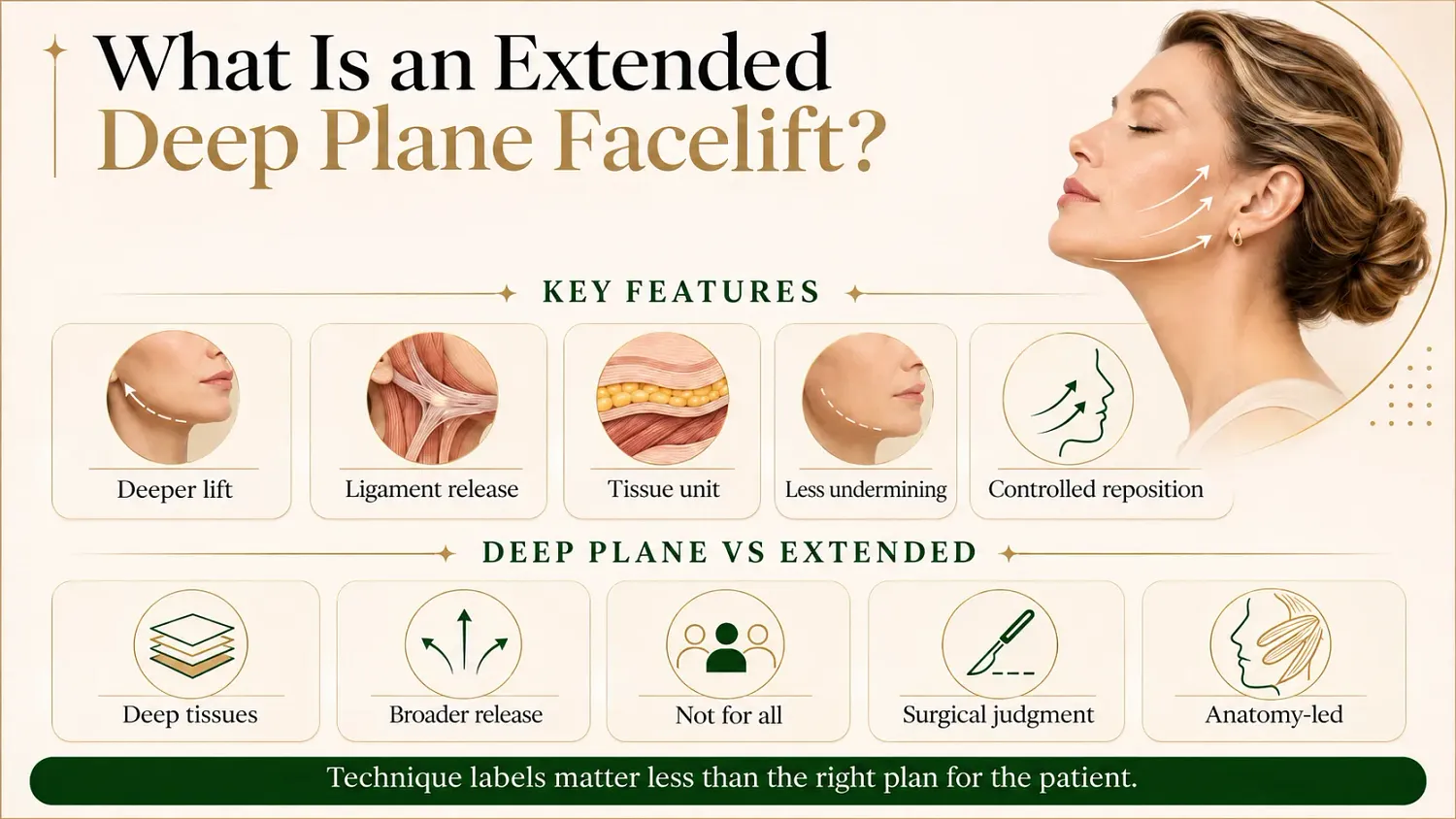
An extended deep plane facelift builds on the same principles but involves a broader release of the structures that limit movement of the deeper facial tissues. The goal is not simply to dissect farther. It is to create enough mobility to reposition the face in a controlled and anatomically appropriate direction.
Dr. Moreno's documented approach uses a composite flap, limited skin undermining, and release of key supporting structures so that the deeper tissues can move more freely. His technique is designed to mobilize the SMAS effectively and create a refreshed result without depending on aggressive skin tension.
Both procedures are based on the idea that facial aging is more than a skin problem. The difference is generally related to how extensively the deeper tissues and retaining ligaments are released. A standard deep plane facelift may mobilize the deeper tissues to a certain degree, while an extended deep plane technique may continue farther to improve mobility.
The word "extended" should not be mistaken for "more aggressive" or "better." The correct operation depends on anatomy, goals, skin quality, facial structure, and the surgeon's assessment. A technique should serve the patient, not the other way around.
Dr. Moreno's approach to aesthetic surgery is centered on natural, refined results. He has said that the best outcome is often one in which others think the patient looks rested or refreshed, rather than immediately assuming they have had surgery.
That philosophy shapes how he approaches facelift surgery. Rather than changing the face into something unfamiliar, his goal is to restore proportion, improve tissue position, and preserve the patient's identity. Restraint and judgment are central to that process.
A facelift is not simply about moving tissue upward or backward. The direction in which tissue is repositioned can affect whether the result looks youthful or artificial. Excessive lateral tension may create a stretched or windswept appearance that patients often want to avoid.
Dr. Moreno's procedure notes describe a vector of pull that is planned in relation to the zygomatic ligament. His goal is to restore facial contours while avoiding the overly pulled appearance sometimes associated with older facelift techniques.
One of the defining features of Dr. Moreno's extended deep plane facelift approach is limited skin undermining. This means the skin is not separated as extensively from the deeper tissues as it may be in some traditional techniques.
The philosophy behind this approach is straightforward. If the deeper tissues are repositioned effectively, the skin does not need to provide the main lifting force. The skin can instead be redraped more naturally over the newly supported facial structure.
For many patients, changes along the jawline are among the most noticeable signs of facial aging. Jowls can develop as soft tissue descends, and the once-smooth transition between the face and neck may become less defined.
Dr. Moreno's facelift philosophy places strong emphasis on creating a more defined jawline while maintaining facial harmony. His internal procedure notes specifically identify a crisp, "snatched" jawline as an aesthetic goal, although the degree of improvement always depends on the patient's anatomy.
The face and neck age together, but they are not the same anatomical problem. Some patients have prominent jowls with relatively little neck laxity, while others may have platysmal bands, submental fullness, or deeper neck structures that contribute to an aged appearance.
Dr. Moreno evaluates the neck independently and may incorporate neck lift techniques when appropriate. His documented approach includes treatment of platysmal banding, lateral platysmal support, and selected deeper neck structures.
A facelift primarily addresses the lower and midface, depending on the technique used. It does not automatically correct upper-eyelid heaviness, lower-eyelid bags, or brow descent. These concerns may require additional procedures.
Dr. Moreno may combine facelift surgery with upper or lower blepharoplasty or brow surgery when appropriate. His eyelid philosophy is conservative, with an emphasis on avoiding unnecessary muscle removal and preserving natural volume around the eyes.
Facial aging also involves changes in volume. Some areas become depleted over time, creating hollows or flattening that cannot be corrected simply by lifting tissue. In these patients, repositioning alone may not fully restore youthful proportions.
Dr. Moreno may use facial fat grafting when volume loss is an important part of the aging process. His documented approach also includes fat grafting for selected patients who have experienced facial volume changes after significant weight loss, including after GLP-1-associated weight reduction.


Published
4 minute read
Dr. Moreno's documented extended deep plane facelift technique generally does not rely on surgical drains. Instead, he uses techniques designed to close dead space and improve tissue contact. His protocol may also include selective use of a hemostatic net and Artiss fibrin sealant in areas of undermining.
That does not mean drains are inherently undesirable. Different surgeons use different methods depending on their technique and patient factors. The more meaningful question is how the surgeon manages fluid accumulation, bleeding, and tissue adherence during recovery.
There is no single age at which someone becomes a facelift candidate. Facial aging varies substantially between individuals. Genetics, weight changes, skin quality, sun exposure, facial structure, and other factors can influence when meaningful laxity develops.
Dr. Moreno evaluates candidacy based on anatomy rather than age alone. Patients with jowling, lower-face laxity, cheek descent, or declining jawline definition may benefit from surgery if they are healthy and have realistic expectations.
Recovery after facelift surgery evolves in stages. Bruising, swelling, tightness, temporary numbness, and uneven swelling may occur early in the healing process. These changes gradually improve as the tissues settle.
Patients should understand that looking socially presentable and reaching a final surgical result are not the same thing. Healing continues for weeks and months, and patients planning an important event should discuss timing carefully during consultation.
Every facelift is a surgical procedure and carries risk. Potential complications can include bleeding, hematoma, infection, delayed wound healing, unfavorable scarring, asymmetry, sensory changes, hairline changes, skin-healing problems, and nerve injury. Anesthesia carries additional risks.
Deep plane surgery requires detailed knowledge of facial anatomy because the surgeon works close to important nerves and vascular structures. No surgical technique eliminates risk, and no responsible surgeon can guarantee a particular cosmetic outcome.
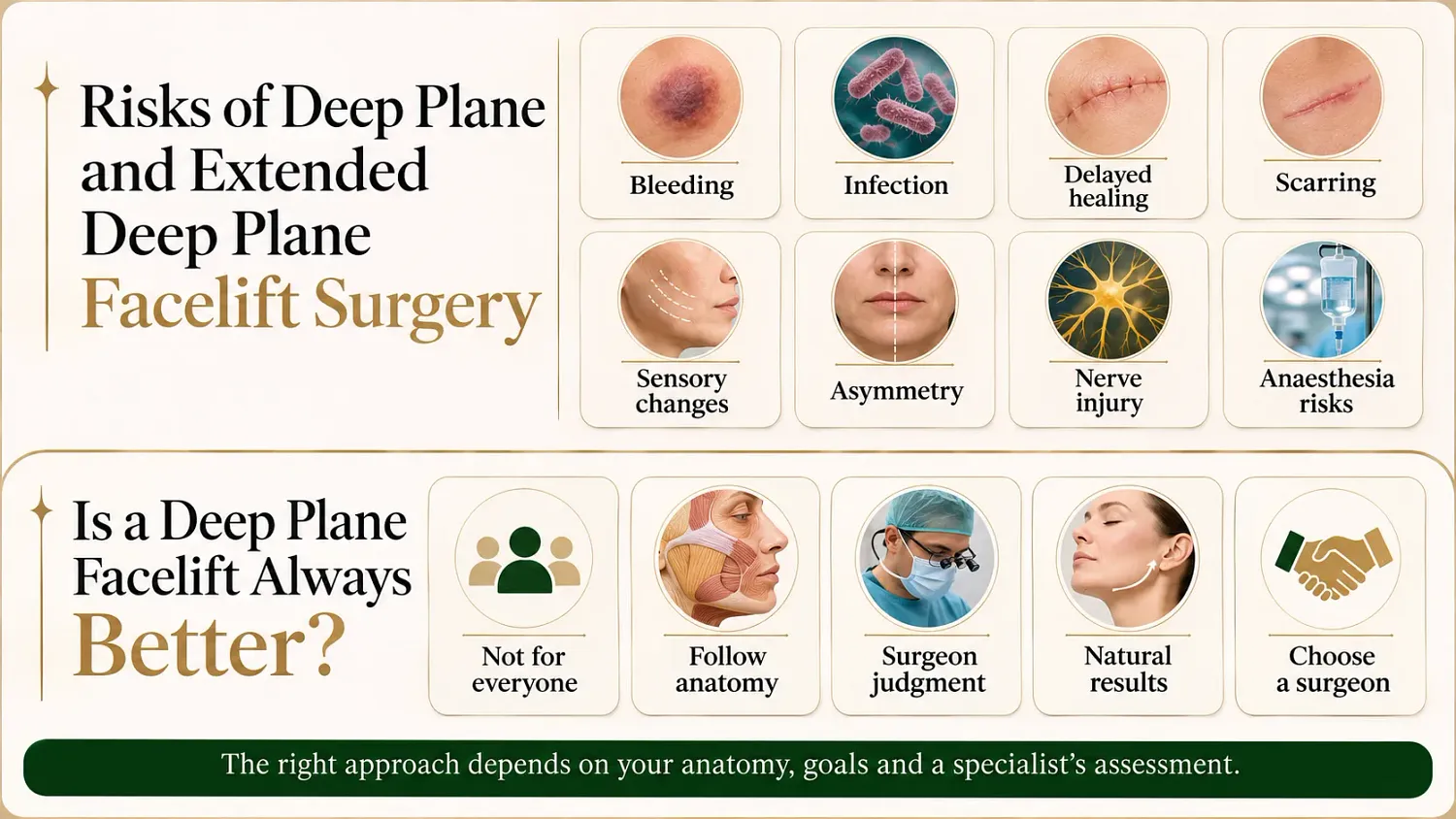
The popularity of deep plane facelift surgery has led some patients to believe that it is automatically superior to every other facelift technique. That is not necessarily true. The best approach depends on the patient's anatomy, degree of aging, goals, and the surgeon's judgment.
A procedure name alone cannot guarantee a result. A technically sophisticated operation can still look unnatural if the vector is poorly chosen, tissues are overcorrected, or the surgical plan does not fit the patient.
A natural-looking facelift is not simply a small facelift. Doing too little can leave the patient disappointed, while doing too much can create an operated appearance. The challenge is to create enough change to restore facial structure while preserving individuality.
Dr. Moreno has described restraint and judgment as central to exceptional plastic surgery results. His training includes six years in an integrated plastic surgery residency at the University of Kansas Medical Center followed by a completed aesthetic surgery fellowship at Aristocrat Plastic Surgery in New York.
Patients researching a deep plane facelift in Houston should look beyond marketing terminology. The consultation should include a detailed discussion of facial anatomy, tissue descent, neck anatomy, recovery, risks, and the surgeon's approach to natural results.
Dr. Moreno's consultation philosophy is built around conversation rather than sales. He has said that he takes time to understand the patient's goals, explain realistic expectations, and make sure they are fully informed before discussing next steps.
Both techniques reposition deeper facial tissues beneath portions of the SMAS. An extended deep plane facelift generally involves broader release of retaining structures to allow greater mobility of the composite facial tissues. Exact definitions can vary between surgeons.
Yes. Jowls and loss of jawline definition are common reasons patients seek facelift surgery. By repositioning deeper tissues, the procedure may create a smoother lower-face contour and better definition along the jaw.
Dr. Moreno's documented extended deep plane facelift approach generally does not use drains. Instead, he employs techniques designed to close dead space and improve tissue contact.
Not automatically. The neck should be assessed independently. Some patients benefit from combined face and neck surgery, while others may require little or no additional neck treatment.
Yes, when appropriate. Upper or lower blepharoplasty may be combined with facelift surgery if aging around the eyes contributes to the patient's overall concerns.
There is no ideal age. Candidacy is better determined by anatomy, facial laxity, general health, goals, and expectations than by chronological age.
A facelift can create long-lasting structural improvement, but it does not stop the aging process. Longevity varies according to anatomy, skin quality, lifestyle, surgical technique, and individual healing.
Published
2 minute read
The most successful facelift should not announce itself. It should restore definition, soften the visible effects of aging, and leave you looking recognizably like yourself. For Dr. Mathew Moreno, that philosophy is summed up in three words: restoration, not transformation.
If you are considering a deep plane or extended deep plane facelift in Houston, schedule a consultation with Dr. Moreno at Body by Ravi Plastic Surgery & Associates to discuss your facial anatomy, goals, and the surgical options that may be appropriate for you. Your face should still tell your story. The goal is simply to help it tell that story with a more rested, refined, and refreshed appearance.